
Blue Sky thinking for Flying Rides
Back in 2015 we started work on our first film for the Flying Theatre format, a project that combined 8k aerial photography and CGI. It was the start of a journey that challenged our technical team for delivering seamlessly joined shots (with no fades or dissolves) into a single camera across the entire piece, that has now become our trademark for the flying ride content we create.
As an established visual effects company who have been at the forefront of augmentation of filmed footage and computer generated images on such shows as BBC Planet Earth and Netflix Night on Earth, we have been privileged to be working with the best landscape photographers in the world and directors who put their trust in us to make their raw images sing.
We come to these projects from a slightly different perspective to most traditional film makers and production companies. Being at the forefront of the technological advancements in our industry in the course of our day to day work has you might say given us a competitive edge. This means that it really is blue sky thinking at the start of the project as anything is possible when combined with our visual effects expertise.
At the start of every project we undertake a thorough previsualisation process. Having worked on so many leading projects for filming in the natural world we have a customised version of Google Earth that allows us to plan every shot with real world attributes, replicating exact terrain, altitudes, flight paths with accurate geographical data to give as true a representation of the proposed scenes prior to filming. This becomes our 3d blueprint for the project which is shared with pilots to replicate the filmed camera movement, test the ride motion prior to filming and give the client a good indication of how the story fits together.
So much of the success of the final output of a good film for a Flying Ride is down to the camera movement and the choreography of the action. Even with the best camera operator in the world and the best equipment, getting everything to be perfect in camera on the day, with unpredictable weather and lighting is a huge challenge. Add to that filming night scenes with restrictions on flying speeds and altitudes and you start to understand how difficult it can be to get the perfect shot.
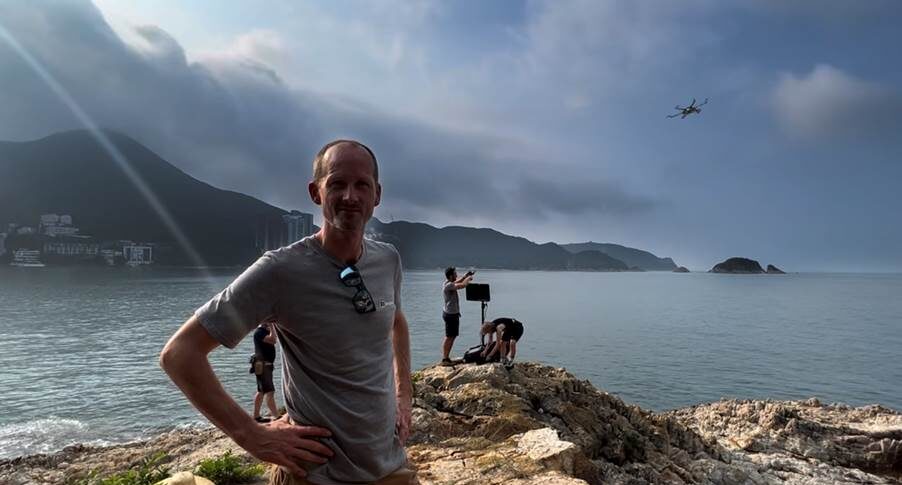
Having earlier this year returned from filming for our latest flying ride for Hong Kong as the Creative Director and Visual Effects Supervisor, we were faced with such challenges. At the start of the rainy season we knew that we were likely to be faced with grey skies, gusty winds on a number of days and many restrictions for filming close to buildings (the filming laws in HK changed extensively 2 years ago). Far from the ideal filming window! We used a purpose built drone and helicopters, knowing that we could get the basic camera motion and the flight paths as we wanted but with no guarantee on the weather. Our good friends at Talesmith did a fantastic job planning all the logistics. We were heavily reliant on the skills of Moonraker, our VFX team, to craft their magic to put back in all the elements of the shots that we wanted to improve as if we had the perfect conditions on every shot so that the production could deliver on time.
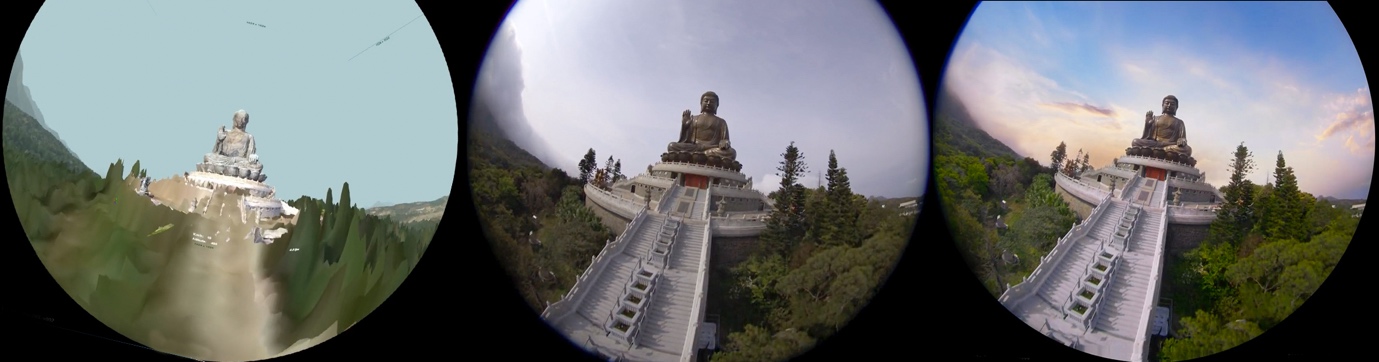
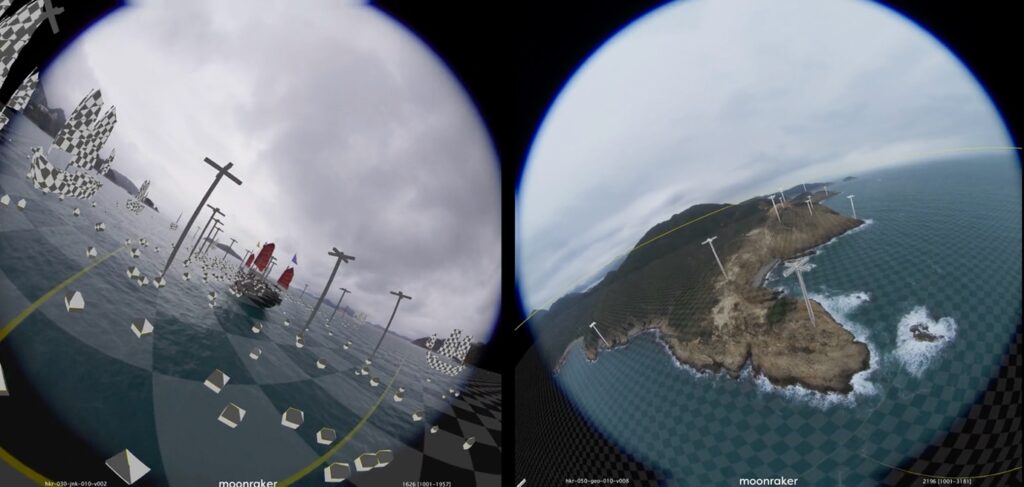
This is where the skills of our VFX camera tracking team come into play. You can record gyro data from the camera and there are lots of pieces of software that allow you to stabilise the footage for conventional formats. However, when it comes to flying rides it’s another world. The world of fisheye. Unlike 360 VR that can be unwrapped into a flat format and worked on fairly easily in post production, 180 degree field of view is worked on in its native format. This means you have to track the camera with all the inbuilt distortion that is characterised with the fisheye lens. Replacing elements of the shot will only be successful if the camera tracking is rock solid. Otherwise new CGI integrated into the filmed material will appear to float over the original image. Similarly, this same process is used to smooth out the motion of the camera and take out the unwanted bumps which can become even more prenounced when the footage is speeded up.
Thus our reliance on post production is huge. Replacing skies, removing dirt on the lens, painting out unwanted cranes, signs and people. The tasks can be exhaustive but knowing exactly what can be done before and after the camera stops rolling and how to achieve it cost effectively and technically offers the filmmaker many more creative choices.
Some elect not to take on such filming challenges for the creation of the material but I’d argue if you can film it and you have a strong postproduction pipeline then don’t be put off.
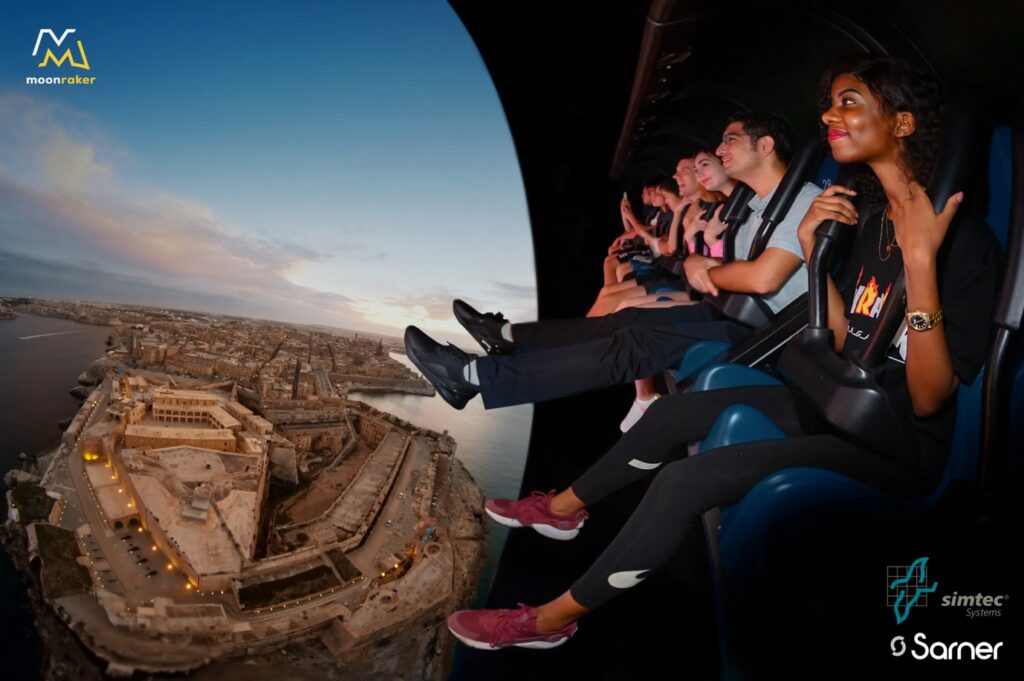
There are however times when the storytelling leads us into worlds that are almost impossible to film. With a sense of flight required to the camera motion, realising underwater worlds for example with dynamic movement or historical scenes can be prohibitive. Our most recent Flying Ride project for the small Mediterranean island of Malta encompasses such scenes. A country rich in history that dates back to the Ottoman Empire, the audience gets to experience flying through crystal-clear waters into a cave before being propelled with cannon balls through an historical battle. All rendered with extremely high production level of VFX comparable to that of a Hollywood movie.
Our next flying ride film will take visitors back to the Moon. Now there’s a challenge for filming. Thankfully we have all the tools to crew that Mission!
Simon Clarke
Execuive Creative Director and Founder Moonraker VFX