
Do Theme Parks Really Need IP? A day at Puy du Fou Suggests Otherwise.
The theme park industry has spent much of the last two decades pursuing a familiar formula: take a globally recognised intellectual property, build an attraction around it, and visitors will come. Whether it’s superheroes, wizards, dinosaurs, or galaxies far, far away, the assumption is often that audiences need a pre-existing emotional connection to a brand before they’ll invest their time and money. My Saturday spent at Puy du Fou, Spain challenged that idea entirely.
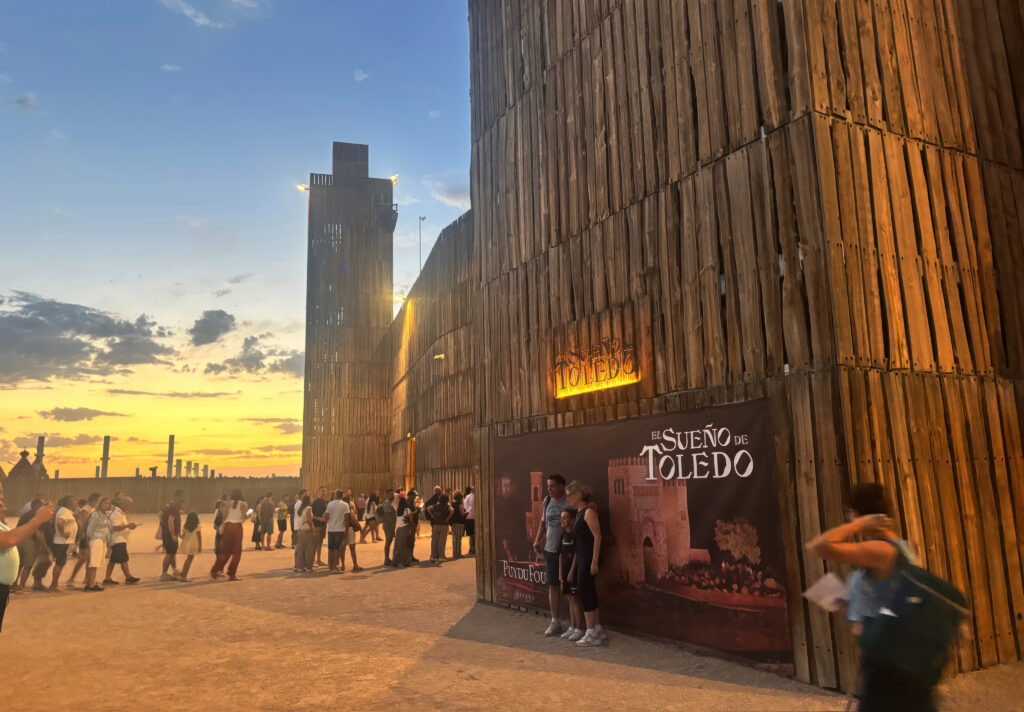
Located just outside of Madrid’s original capital, Toledo, Puy du Fou (including the original site in France) has become one of Europe’s most successful visitor attractions without relying on famous film franchises or established entertainment brands. Instead, it has built its reputation around something far older: history itself. And not history presented as a museum exhibit or educational lecture, but history brought vividly, emotionally and spectacularly to life.
As someone who has spent his career helping to tell historical stories through visual effects, I found the experience particularly fascinating. At Moonraker VFX, we’ve been fortunate to work on productions including Valley of the Kings, Secrets of the Ancients, Ancient Apocalypse, The Last Czars, World War II From Space, Lost Cities with Albert Lin, the Beyond All Boundaries museum experience, and the Bodmin Jail Experience, to name but a few. Across all of these projects, the objective is remarkably similar: help audiences connect with people, places and events that no longer exist in a tangible form.
Whether recreating ancient civilisations, long-lost cities, Roman landscapes, royal courts or wartime battlefields, visual effects storytelling serves as a bridge between the present and the past. It transforms historical information into something audiences can experience rather than simply observe.
That same philosophy appears to sit at the heart of Puy du Fou.
What struck me most wasn’t any single show, (although only having a day there my focus of interest was to see the ones with screen and projected media) but the extraordinary integration of disciplines working together to create immersion. One especially effective moment in the show ‘El Ultimo Cantar’ involved a shoreline setting, where the combination of real water was extended seemlessly into the projected backdrop of the sea, the combined image served to create a more unified sense of depth, and bring the immersive experience of the scene to life that felt like the live actors inhabited.
The parks other productions seamlessly combine world-class set design, practical effects, live performance, stunt work, media content, projection, lighting, sound and theatrical storytelling. None of these elements dominate. Instead, they work in harmony to create moments where audiences stop analysing how something is being achieved and simply become absorbed in the story being told.
Throughout Puy du Fou, the technical achievement is impressive, but it is always in service of emotion, character and historical context and even though my Spanish is rudimentary to say the least, this still carried through.
As visual effects artists, this is a lesson I understand well. Audiences rarely remember the complexity of the simulation, the reconstruction process, or the rendering pipeline. What stays with them is how a story made them feel. They remember standing in ancient Egypt, witnessing the rise of a lost civilisation, or experiencing a pivotal historical event as though they were present. It’s the same principle behind the enthusiastic responses to our work for Odyssey Malta, an immersive flying theatre experience that allowed visitors to journey through history in a way that felt immediate, tangible and emotionally engaging. That emotional connection is precisely what Puy du Fou delivers.
The park also raises an interesting premise to the wider attractions industry. If a history-based destination can attract millions of visitors through original storytelling and immersive experiences, perhaps intellectual property isn’t the only path to success. Maybe audiences are simply looking for compelling worlds to step into? History offers an almost limitless catalogue of stories, characters, conflicts and cultures waiting to be rediscovered, I note the new run of these populating Immerse London (Tutankhamun, Pompeii and The Timewalk Exhibition opening this July).
Having spent 3 decades working in television filming on sets as a visual effects supervisor I’ve had the pleasure of reconstructing vast battle scenes, rebuilding ancient empires and encovering hidden tomb stones with CGI. The success of factual television demonstrates that there is enormous appetite for these subjects when they are presented in engaging ways. Shows exploring archaeology, engineering, science, exploration and human achievement continue to attract audiences worldwide.
Which leads to an intriguing question;
If history can work so effectively in an immersive theme park format, what other factual genres could do the same? Could visitors journey through the great scientific discoveries that shaped civilisation? Experience the race to space through large-scale live spectacle? Explore the hidden worlds of deep oceans, natural history, lost ecosystems or future technologies? Could engineering, archaeology, exploration or even geology become the foundation for immersive attractions every bit as compelling as traditional entertainment franchises?
For companies like Moonraker VFX, these possibilities are particularly exciting. Our industry has spent years helping factual producers reconstruct forgotten worlds and visualise the unseen. As technologies continue to evolve, the opportunities to blend visual effects, physical environments, media integration and live storytelling become increasingly powerful.
Puy du Fou demonstrates what can happen when creative ambition is applied to subjects that already belong to all of us. It proves that audiences don’t necessarily need familiar characters or blockbuster franchises to be captivated.
Sometimes the most compelling stories are the ones that actually happened.
And when they’re brought to life with enough craft, imagination and technical excellence, history itself can become the ultimate intellectual property.